
A supply chain investigation reveals ultra-cheap Chinese-manufactured video doorbells and cameras (sold under brands like Eken and Tuck) contain hardcoded root passwords and firmware "fixes" that merely disable vulnerable services without removing them. These devices, often using Allwinner chipsets, route metadata and video through servers in China and Hong Kong, creating a massive, vulnerable IoT surface that can be centrally controlled. The manufacturers are shielded by shell companies and non-responsive legal entities, making enforcement and remediation nearly impossible.
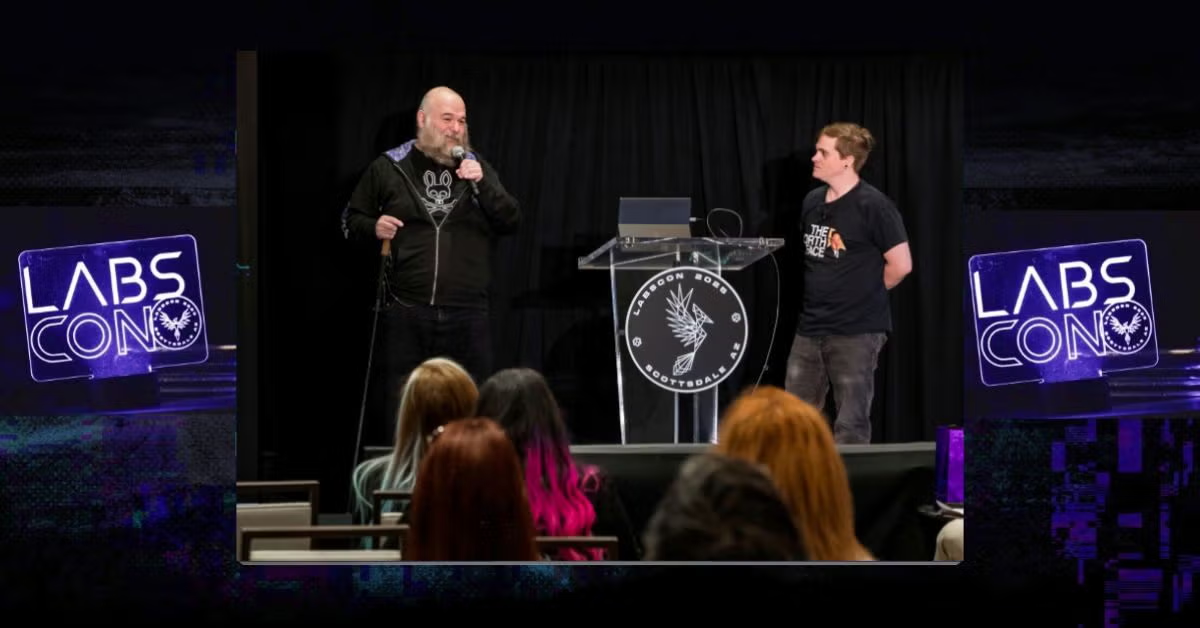
In this LABScon 25 presentation, Marc Rogers and Silas Cutler explore the complex, “shadow” supply chain of ultra-cheap Chinese smart home devices, specifically focusing on video doorbells and security cameras widely sold on mainstream online shopping platforms under various rotating brand names like Eken and Tuck. Marc, who assisted the FCC Enforcement Bureau in its investigations, and Silas reveal how these devices often share identical hardware platforms powered by Allwinner semiconductors, a company heavily subsidized by the Chinese government. Firmware analysis uncovered hardcoded root passwords and supposed security fixes that amounted to little more than commenting out vulnerable services from startup scripts rather than removing them. Despite appearing to use local cloud services, metadata and video content are frequently routed through servers in Hong Kong and China. Rogers and Cutler trace a network of shell companies and fictional personas entirely absent from tax and voter records. These entities use non-responsive registered agents and PO boxes specifically set up to refuse legal service, effectively shielding the actual manufacturers from regulatory oversight and making enforcement nearly impossible. The rapid iteration of hardware versions with no long-term support mirrors distribution patterns more commonly associated with malware campaigns. While the investigation stops short of attributing direct malice, Rogers and Cutler argue that these devices collectively form a massive, vulnerable IoT surface that can be controlled through simple configuration pushes from overseas. Consumers are drawn in by low prices and subscription features, unaware that their data ultimately resides under foreign control. About the Authors Marc Rogers is Co-Founder and Chief Technology Officer for the AI observability startup nbhd.ai . Marc has served as VP of Cybersecurity Strategy for Okta, Head of Security for Cloudflare and Principal Security researcher for Lookout. In his role as technical advisor on USA’s “Mr. Robot” and the BBC’s “The Real Hustle”, he helped create on-screen hacks for both shows. Silas Cutler is a Principal Security Researcher at Censys. With over a decade of experience tracking threat actors and developing methods for pursuit. Before Censys, he worked as Resident Hacker for Stairwell, Reverse Engineering Lead for Google Chronicle, and as a Senior Security Researcher on CrowdStrike’s Intelligence team. LABScon 2026 | Call For Papers Submission Deadline: June 19, 2026 LABScon is a unique venue for original research to be shared among peers. The benefit of an invite-only audience of researchers is that there’s no need for long preambles or introductions – speakers are encouraged to dive right into their technical findings. Original content only. Talks are 20 minutes long + 5 minutes for Q&A. Workshops are 90 minutes long. LABScon is primarily a threat intelligence and vulnerability research conference but we keep an open-mind. About LABScon This presentation was featured live at LABScon 2025, an immersive 3-day conference bringing together the world’s top cybersecurity minds, hosted by SentinelOne’s research arm, SentinelLABS. Keep up with all the latest on LABScon here.