
The CopyFail, Dirty Frag, and Fragnesia vulnerabilities (CVE-2026-31431, CVE-2026-43284, CVE-2026-43500) are local privilege escalation flaws in the Linux kernel's zero-copy functionality, allowing an attacker with an existing low-privilege foothold to trivially gain root access by corrupting page-cache data via syscalls like splice and vmsplice. With CVSS scores ranging from 7.8 to 8.8 (HIGH), affected kernel versions span from 4.11 through 6.12.87, depending on the specific CVE and kernel series. Patches are available in specific fixed versions per kernel series, such as 5.10.254 for CVE-2026-31431; short-term mitigations include disabling specific kernel modules (algif_aead, esp4, esp6, rxrpc), though these can impact production services like IPsec/VPN and AFS.
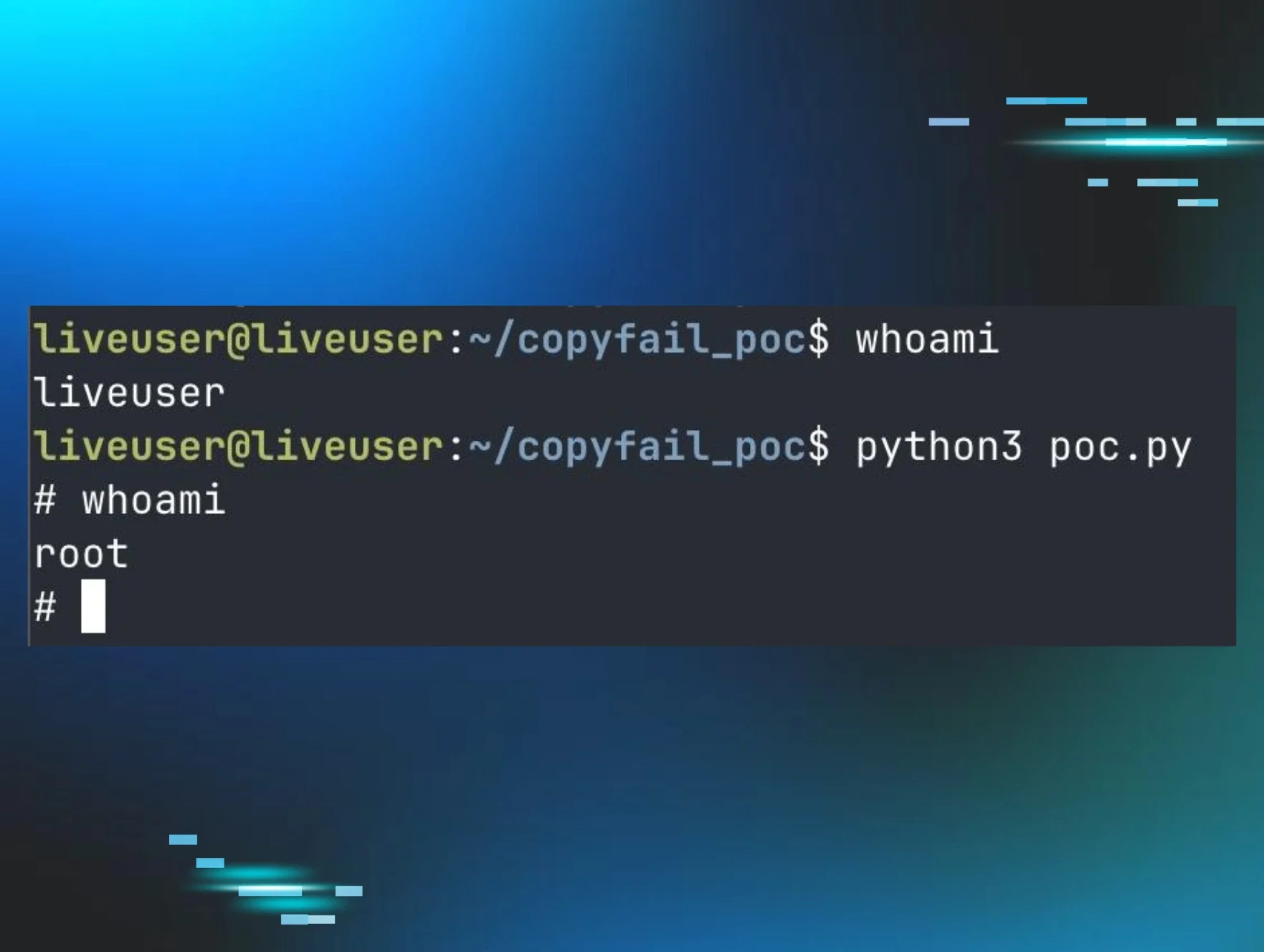
Home Blog Panic at the Distro Published: May 14, 2026 Panic at the Distro By: Chris Ryan Uttie Gumbula Key Takeaways CopyFail, Dirty Frag, and Fragnesia are easy-to-exploit Linux privilege escalation vulnerabilities. While they do not provide remote code execution on their own, an attacker with an existing foothold can abuse them to quickly gain root access on affected systems. These bugs are part of a broader class of page-cache corruption issues tied to zero-copy functionality. They abuse trusted syscalls dealing with memory such as splice, vmsplice, and related zero-copy mechanisms to alter cached file contents in RAM without changing the file on disk. Short-term mitigations exist, but they can affect production workloads. For CopyFail, disabling algif_aead can reduce exposure; for Dirty Frag and Fragnesia, disabling esp4 , esp6 , and rxrpc can help, but these mitigations may impact IPsec/VPN and RxRPC/AFS-dependent environments. Because exploitation requires prior access, defenders should treat these vulnerabilities as privilege-escalation accelerants. Preventing initial compromise still matters, but organizations should prioritize hardening and patching to stop attackers from turning a low-privilege foothold into full system control. Patching is the most effective long-term fix. Huntress recommends organizations move to the latest supported kernel versions from their distribution as patches become available. Acknowledgments: Special thanks to Jamie Levy, Tom Lawrence, Jim Deville, Tyler Bohlmann, and Shivangi Pandey for their contributions to this write-up. TL;DR It’s never a good day for administrators when a branded vulnerability drops, especially when multiple of them land in rapid fire. Over the last two weeks, security researchers independently discovered multiple vulnerabilities in the Linux kernel that allow an unprivileged user to easily gain root access (local privilege escalation). All of these named vulnerabilities pertain to the Linux kernel’s zero-copy functionality, and are named CopyFail (CVE-2026-31431), Dirty Frag (CVE-2026-43284 and CVE-2026-43500), and Fragnesia (CVE-2026-46300). While these vulnerabilities require an attacker to have established access on a victim machine, and none allow for remote code execution, they are trivially easy to exploit. An attacker can abuse native tooling (e.g., Python with only the standard library), resulting in the attacker having administrator (root) access. Once an attacker gains root, they have full administrative access to the victim’s system, allowing them to install further malicious tooling, exfiltrate data owned by privileged users, or bypass security tooling. Further complicating things for defenders is the widespread nature of these vulnerabilities; when they were first publicly announced, most popular Linux distributions were affected (given that they reside in core components in the kernel, which ship with virtually every distribution), with little time for kernel developers to patch and for distributions to roll out. Figure 1: Unprivileged user running the CopyFail exploit to gain root access Cache rules everything around me On April 29, 2026, researchers at Xint Code announced the CopyFail vulnerability and proof-of-concept (PoC) exploit , demonstrating the ease at which an unprivileged user could gain root. Days later on May 7, researcher Hyunwoo Kim announced the Dirty Frag vulnerabilities and PoC exploit , which, when chained together, have the same local privilege escalation result as CopyFail. On May 13, William Bowling of the V12 security team announced the Fragnesia vulnerability and PoC exploit , again leading to direct root access. All of these vulnerabilities were uncovered with the help of large language models, and were placed in the public knowledge shortly after discovery. CopyFail is a vulnerability in the Linux kernel’s algif_aead crypto API, which allows a socket interface for authenticated encryption. This vulnerability was introduced to the 4.14 Linux kernel in 2017 via commit 72548b093ee3 . The vulnerability comes as a result of a zero-copy optimization, when AEAD reuses the source memory as the destination. This allows an attacker to overwrite a cached file, namely a page cache, via the splice syscall. Dirty Frag is a similar vulnerability, like CopyFail and 2022’s Dirty Pipe vulnerability. According to the author of the Dirty Frag exploit, “while Dirty Pipe overwrites struct pipe_buffer , Dirty Frag overwrites the frag of struct sk_buff ”, hence the appearance of “frag” in the name. While CopyFail abuses the page cache of the algif_aead submodule, Dirty Frag affects the xfrm-ESP and the RxRPC submodules and their page cache. The Dirty Frag vulnerabilities were introduced to the Linux kernel in 2017 and 2023, respectively. The author further explains , “What both vulnerabilities have in common is that, on a zero-copy send path where splice() plants a reference to a page cache page that the attacker only has read access to into the frag slot of the sender side skb as is, the receiver side kernel code performs in-place crypto on top of that frag. As a result, the page cache of files that an unprivileged user only has read access to (such as /etc/passwd or /usr/bin/su ) is modified in RAM, and every subsequent read sees the modified copy”. Fragnesia is related to the same area of the kernel and a variant of the Dirty Frag vulnerability. Fragnesia affects the XFRM ESP-in-TCP kernel subsystem. According to the Fragnesia PoC author, “it abuses a logic bug in the Linux XFRM ESP-in-TCP subsystem to achieve arbitrary byte writes into the kernel page cache of read-only files, without requiring any race condition”. Like the other vulnerabilities, successful exploitation of Fragnesia also leads to local privilege escalation and root access. All of these vulnerabilities (CopyFail, Dirty Frag, Fragnesia and Dirty Pipe) suffer from the same weakness; a kernel subsystem, via a reference to a page cache, performs an in-place write which is corrupted, and the page-cache corruption is present to every reader of the underlying file. This allows an attacker to get access to a protected file and become root. From hero to zero(copy)-day An old programming joke goes “there are two hard problems in computer science: naming things, cache invalidation, and off-by-one errors”. While not strictly a cache invalidation issue, page caching is still hard, and today we are going to dive into the second part, abusing the page cache. CopyFail, Dirty Frag, and Fragnesia belong to a wider family of vulnerabilities that rely on memory page cache corruption. This kind of attack was most recently seen in 2022’s Dirty Pipe vulnerability ( CVE-2022-0847 ), which when successfully exploited also resulted in local privilege escalation. These exploits take advantage of zero-copy syscalls like sendfile , splice , and vmsplice , to populate the cache with poisoned data. Since the operating system has implicit trust in the contents of the page cache, any future requests to the target file (or pipe, or socket), now returns from this cache, and the poisoned data persists in the cache, invisible. One of the speed optimizations an operating system can take is that it looks at what is already in memory; what is insidious about these kinds of exploits is that they hook into the in-memory aspect of the vulnerability (the file that is read on-disk, e.g., the su binary, is unchanged, but its copy in memory is now corrupted). So, what is zero-copy? This legitimate functionality has been around for a while in the Linux kernel, since at least kernel version 2.2, which was released in 1999. Zero-copy is one of those "hidden" performance boosters that underpins almost everything we do online, from streaming 4K video to high-frequency trading. At its core, zero-copy is about efficiency — specifically, eliminating the need for the CPU to move data between memory buffers, which significantly boosts system performance and throughput. Every time data is moved the traditional way, the CPU burns cycles shuffling it around. Zero-copy lets the hardware (like the NIC) pull data directly from the kernel's memory without the CPU acting as an intermediary. What would have been 4 context switches and 4 data copies is reduced to typically two context switches and zero CPU-driven memory copies –hence "zero-copy." Instead of making copies, we move data via Direct Memory Access (DMA), often by passing pointers/references to the existing kernel buffer rather than the data itself. This is distinct from the typical malloc or new command, and by design the data never even enters the application's memory region. How does caching get involved here? The page cache is the kernel's way of keeping recently accessed disk data in RAM. When an application requests data, the kernel checks the page cache first; if the data isn't there, it reads from disk, populates the cache, and then returns the data to the app. Subsequent reads come straight from the cache until it's invalidated. When an application uses a zero-copy call (like splice or sendfile ), the kernel effectively says, "If the data you want isn't in the cache, fetch it into memory, then hand the other side a reference to read it directly." This is why these exploits target the cache – they don't modify data on disk; they change what your computer believes is equivalent to the data on disk. Remediations Thankfully, there are a few ways administrators and defenders can prevent these kinds of zero-copy-enabled local privilege escalation attacks from occurring. These exploits require an attacker to already have an initial foothold on the system, so typical protections against initial access apply here. Specific remediations include patching to the latest kernel version your distribution offers (or, upgrading to a supported distribution that does). This is the most effective and long-term solution, as patches are being rolled out at the time of this writin