
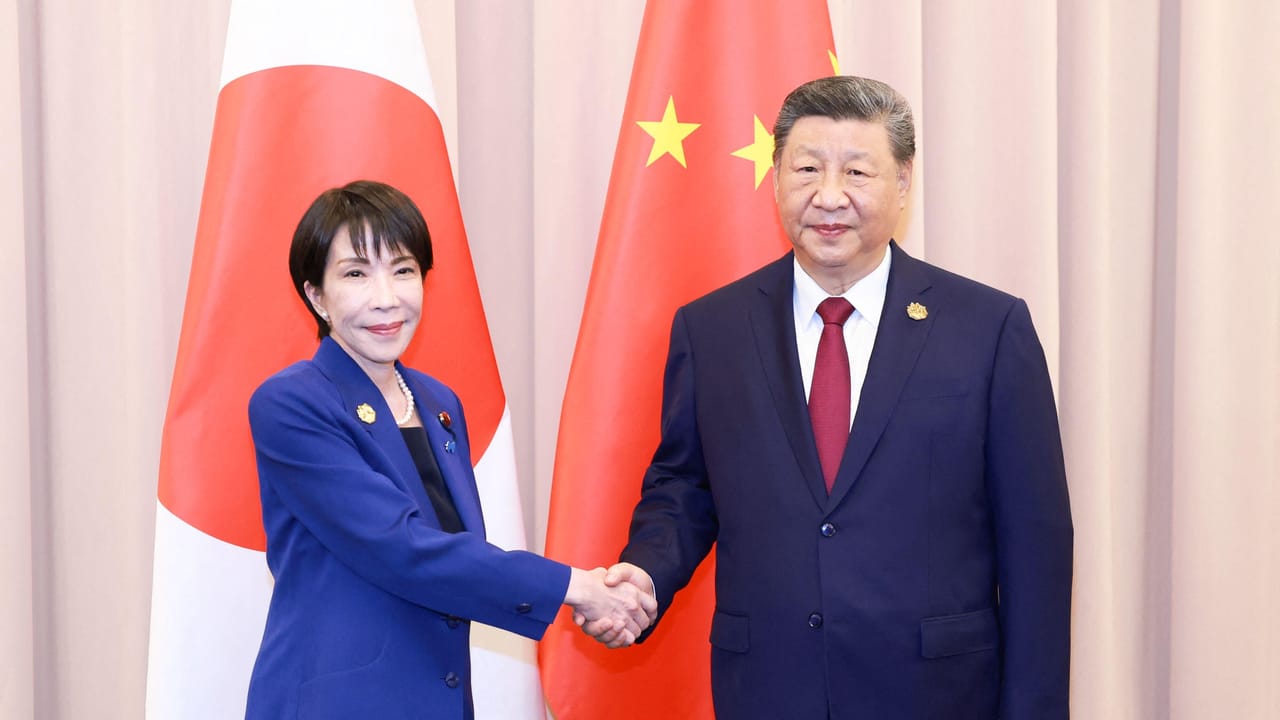
- What: Chinese police/CCP law enforcement used ChatGPT to manage smear campaigns against critics, including Japan's prime minister.
- Impact: Potential political influence operations targeting public figures.
TechTarget and Informa Tech’s Digital Business Combine. Dark Reading Resource Library Black Hat News Omdia Cybersecurity Advertise NEWSLETTER SIGN-UP Cybersecurity Topics World The Edge DR Technology Events Resources CYBERATTACKS & DATA BREACHES THREAT INTELLIGENCE CYBER RISK APPLICATION SECURITY NEWS Breaking cybersecurity news, news analysis, commentary, and other content from around the world, with an initial focus on the Middle East & Africa and the Asia Pacific Chinese Police Use ChatGPT to Smear Japan PM Takaichi A Chinese keyboard warrior inadvertently leaked information about politically motivated influence operations through a ChatGPT account. Nate Nelson,Contributing Writer February 26, 2026 4 Min Read SOURCE: XINHUA VIA ALAMY STOCK PHOTO Someone associated with Chinese Communist Party (CCP) law enforcement used ChatGPT to help manage smear campaigns against CCP critics, including the prime minister of Japan. Every so often, OpenAI reports on recent attempts by threat actors to use ChatGPT maliciously. Besides scammy cybercriminal activity, its latest report, published Feb. 25, highlights nation-states using the chatbot to smooth out politically motivated campaigns — some targeted and petty, others widespread and geopolitical in nature. For instance, OpenAI recently got a unique look into China's propaganda machine through one ChatGPT account linked to Chinese law enforcement. Too lazy to do their own work, the user regularly had ChatGPT draft and edit reports on active smear campaigns against Chinese dissidents, as well as Sanae Takaichi, the current prime minister of Japan. This campaign, and other recent ones, "illustrate how threat actors typically use artificial intelligence (AI) in combination with other, more traditional tools, such as websites and social media accounts," OpenAI wrote. "Threat activity is seldom limited to one platform; as our report on a Chinese influence operator shows, it is not always limited to one AI model." Related:Singapore & Its 4 Major Telcos Fend Off Chinese Hackers CCP Cop Targets China Critics Last October, Takaichi was elected president of Japan's leading Liberal Democratic Party (LDP), and, in turn, prime minister of the country. Already a known China hawk, the new post did not inspire her to tone down her rhetoric. In early speeches and government events, she indicated her intention to lend military support to Taiwan, should China invade it. She also had the gall to reference China's checkered human rights history with ethnic Mongols in the Inner Mongolia Autonomous Region, in northern China, and so on. As some small form of revenge, a keyboard warrior for the Chinese state took to ChatGPT. The user asked the bot to help craft a plan to discredit Takaichi, by posting and amplifying negative online comments about her, as well as using email accounts to impersonate Japanese citizens to send complaints to Japanese politicians about her stance on foreign immigration. Further, they used fake social media accounts and recruited existing Internet users to generate political pressure over the cost of living in Japan, stir up anger over US tariffs, and spread positive sentiments online about the conditions of oppressed peoples in Inner Mongolia. OpenAI wouldn't have willingly published a report about this user had ChatGPT actually complied with their malicious requests. They weren't too dissuaded, though, and continued to use ChatGPT to draft and polish status reports, and other internal documentation less overtly malicious but nonetheless helpful to the operation. Related:Senegalese Data Breaches Expose Lack of Security Maturity The same individual also used ChatGPT as a writing assistant for campaigns against Chinese dissidents and one human rights organization. The documents they generated offered OpenAI a window into CCP's propaganda machine. For instance, one report that the user asked ChatGPT to draft included a claim that 300 people in their province were engaged in these influence operations. Other updates referred to equivalent operations in other Chinese provinces, and indications that the CCP rabblerousers also use other, more liberal AI chatbots, like Qwen and DeepSeek. The documents also referenced more than 100 different tactics used against enemies of the CCP, from basic trolling to hacking, and exploiting targets' mental health and their families. A More Effective ChatGPT Influence Op Elsewhere in its report, OpenAI describes a more effective model for how to weaponize mainstream chatbots in an influence operation. In Operation "No Bell," a Russian threat actor used ChatGPT to generate and edit social media content and longform articles about geopolitical issues in sub-Saharan Africa. One article, for instance, advocated that the president of Angola win the Nobel Peace Prize — apparently, a distant attempt to rile Donald Trump. Another, ironically, accused Western leaders of targeting South Africa with disinformation. Related:Protests Don't Impede Iranian Spying on Expats, Syrians, Israelis ChatGPT got less in the way of this campaign, as the prompts were not in and of themselves objectively malicious. And this strategy appears to have borne fruit for the threat actor. Some 53 of their articles actually appeared on various African news sites, under the byline "Dr Manuel Godsin," a fake PhD from the University of Bergen. The threat actor took care to reduce suspicion of AI generation by asking ChatGPT to write in the style of a human journalist. They also eliminated all em dashes from the final generated text. Em dashes are widely, incorrectly, assumed to be an indication of AI-generated text. After discovering both the Russian and Chinese influence operations, OpenAI banned the accounts, though this will slow the threat actors only for as many seconds as it takes them to register new accounts. Read more about: DR Global Asia Pacific About the Author Nate Nelson Contributing Writer Nate Nelson is a journalist and scriptwriter. He writes for "Darknet Diaries" — the most popular podcast in cybersecurity — and co-created the former Top 20 tech podcast "Malicious Life." Before joining Dark Reading, he was a reporter at Threatpost. More Insights Industry Reports ThreatLabz 2025 Ransomware Report The Total Economic Impact™ Of Zscaler Private Access (ZPA) Zscaler ThreatLabz 2025 VPN Risk Report GigaOm Radar for CNAPP The Total Economic Impact™ of Google SecOps Access More Research Webinars Building a Robust SOC in a Post-AI World Retail Security: Protecting Customer Data and Payment Systems Rethinking SSE: When Unified SASE Delivers the Flexibility Enterprises Need Securing Remote and Hybrid Work Forecast: Beyond the VPN AI-Powered Threat Detection: Beyond Traditional Security Models More Webinars You May Also Like CYBERATTACKS & DATA BREACHES Critical Fortinet Vuln Draws Fresh Attention by Jai Vijayan, Contributing Writer MAR 19, 2025 CYBERATTACKS & DATA BREACHES Cyberattackers Target LastPass, Top Password Managers by Nate Nelson, Contributing Writer OCT 16, 2025 CYBERATTACKS & DATA BREACHES Zscaler, Palo Alto Networks Breached via Salesloft Drift by Alexander Culafi SEP 02, 2025 CYBERATTACKS & DATA BREACHES DeepSeek Breach Opens Floodgates to Dark Web by Emma Zaballos APR 22, 2025 Editor's Choice ENDPOINT SECURITY Ivanti EPMM Zero-Day Bugs Spark Exploit Frenzy — Again byNate Nelson FEB 12, 2026 6 MIN READ CYBER RISK Those 'Summarize With AI' Buttons May Be Lying to You byJai Vijayan FEB 12, 2026 5 MIN READ CYBERATTACKS & DATA BREACHES Senegalese Data Breaches Expose Lack of Security Maturity byNate Nelson FEB 12, 2026 5 MIN READ 2026 Security Trends & Outlooks THREAT INTELLIGENCE Cybersecurity Predictions for 2026: Navigating the Future of Digital Threats JAN 2, 2026 CYBER RISK Navigating Privacy and Cybersecurity Laws in 2026 Will Prove Difficult JAN 12, 2026 ENDPOINT SECURITY CISOs Face a Tighter Insurance Market in 2026 JAN 5, 2026 THREAT INTELLIGENCE 2026: The Year Agentic AI Becomes the Attack-Surface Poster Child JAN 30, 2026 Download the Collection Keep up with the latest cybersecurity threats, newly discovered vulnerabilities, data breach information, and emerging trends. Delivered daily or weekly right to your email inbox. SUBSCRIBE Webinars Building a Robust SOC in a Post-AI World THURS, MARCH 19, 2026 AT 1PM EST Retail Security: Protecting Customer Data and Payment Systems THURS, APRIL 2, 2026 AT 1PM EST Rethinking SSE: When Unified SASE Delivers the Flexibility Enterprises Need WED, APRIL 1, 2026 AT 1PM EST Securing Remote and Hybrid Work Forecast: Beyond the VPN TUES, MARCH 10, 2026 AT 1PM EST AI-Powered Threat Detection: Beyond Traditional Security Models WED, MARCH 25, 2026 AT 1PM EST More Webinars White Papers Industry Report: AI, SOC, and Modernizing Cybersecurity The Threat Prevention Buyer's Guide: Find the best AI-driven threat protection solution to stop file-based attacks. Assessing Security Architectures: Zero Trust vs. Network-Centric Models 5 Steps to Stop Ransomware With Zero Trust 10 Ways a Zero Trust Architecture Protects Against Ransomware Explore More White Papers GISEC GLOBAL 2026 GISEC GLOBAL is the most influential and the largest cybersecurity gathering in the Middle East & Africa, uniting global CISOs, government leaders, technology buyers, and ethical hackers for three power-packed days of innovation, strategy, and live cyber drills. 📌 BOOK YOUR SPACE Discover More Black Hat Omdia Working With Us About Us Advertise Reprints Join Us NEWSLETTER SIGN-UP Follow Us Copyright © 2026 TechTarget, Inc. d/b/a Informa TechTarget. This website is owned and operated by Informa TechTarget, part of a global network that informs, influences and connects the world’s technology buyers and sellers. All copyright resides with them. Informa PLC’s registered office is 5 Howick Place, London SW1P 1WG. Registered in England and Wales. TechTarget, Inc.’s registered office is 275 Grove St. Newton, MA 02466. Home| Cookie Policy| Privacy| Terms of Us